
IPTA · CPT Textbook · Second Edition
The PRIME Method
The framework that organizes every training prescription. Read this first; refer back to it often.
Introduction to IPTA
What You’ll Master
After studying this introduction, you will be able to:
- Explain the PRIME Method as a five-phase progressive training framework.
- Identify the GPP and SPP zones and the goals and strategies of each phase.
- Map a client's stated training goal to the appropriate PRIME phase.
- Apply the PRIME Session Template across all five phases.
- Recognize the textbook's callout system and use it to navigate efficiently.
The International Personal Trainer Academy prepares fitness professionals to deliver safe, effective, and individualized training. This textbook serves both purposes a working trainer needs: passing the NCCA-accredited CPT exam, and walking onto a gym floor with the science, assessment skill, and programming judgment to make a client better than the day they walked in. What follows is the IPTA PRIME Method — the framework that organizes everything in this textbook into one progressive, teachable model.
Introducing the PRIME Method
PRIME is the IPTA framework for organizing personal training into five progressive phases. Each phase builds on the last. Together, they form a pyramid that takes a client from foundational movement preparation all the way through power development.
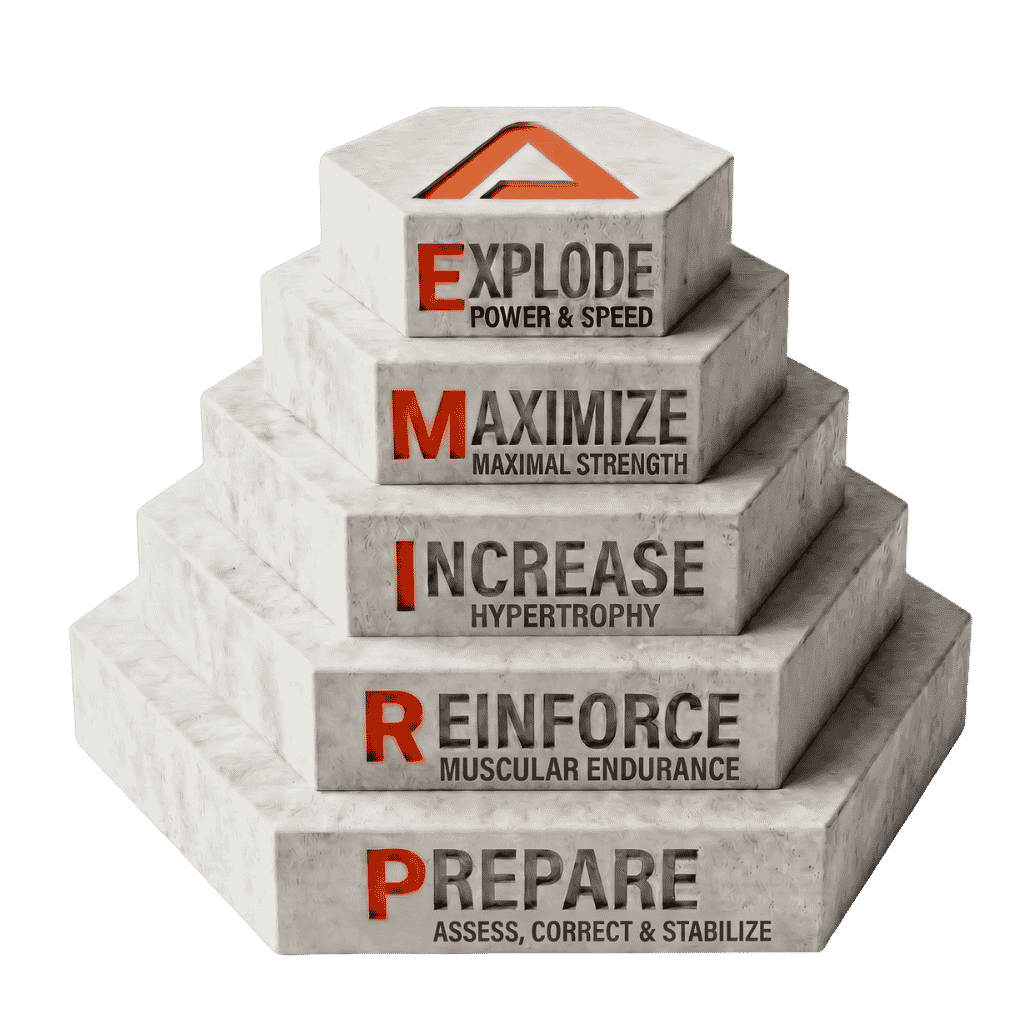
The five phases are:
| Letter | Verb | Subtitle | Zone |
|---|---|---|---|
| P | PREPARE | Assess, Correct & Stabilize | GPP |
| R | REINFORCE | Muscular Endurance | GPP |
| I | INCREASE | Hypertrophy | SPP |
| M | MAXIMIZE | Maximal Strength | SPP |
| E | EXPLODE | Power & Speed | SPP |
The acronym P-R-I-M-E is also the order of progression. Every client begins at the foundation (Phase P) and progresses upward toward the specialization that fits their goals (I, M, or E). Some clients spend months in P. Others, with movement competency already developed, may move quickly through P and R toward their primary goal phase. The framework sets the path; the trainer's judgment sets the pace.
PRIME exists for three reasons. First, it gives you a teaching scaffold — a single mental model that organizes every training prescription you will ever write. Second, it gives you a coaching scaffold — a way to communicate to clients where they are now and where they're heading. Third, it gives the IPTA cert ecosystem its architecture: each PRIME phase corresponds to a specialty certification you can earn after the CPT (Phase P → CES, Phase I → CBS, Phases M+E → S&C), making the entire progression of an IPTA-trained career visible from day one.
Throughout this textbook, every training chapter is tagged with the PRIME phase (or phases) it teaches. Look for the Phase X. VERB — Subtitle label at the top of each chapter; this tells you exactly where the content fits in the pyramid.
The GPP / SPP Zone Framing
PRIME's pyramid divides into two zones drawn directly from established periodization science: General Physical Preparation (GPP) and Specific Physical Preparation (SPP). This is the conceptual core of how PRIME organizes training. Read this section twice.
Phases P and R together form the GPP zone — the broad foundation every client needs before specialization.
Phases I, M, and E form the SPP zone — the specialization toward a single dominant adaptation.
GPP — General Physical Preparation. Phase P (Prepare) covers the broad foundation: assessment, corrective work, mobility, balance, aerobic base, low-load stabilization training. Phase R (Reinforce) covers the resistance training foundations: technique mastery, the science of how muscles adapt to load, the protocols and systems that structure RT, and muscular endurance as the entry-level RT prescription. Together, P and R prepare a client to pursue any specialization without injury, with sound technique, and with the aerobic and muscular base that makes harder work productive.
SPP — Specific Physical Preparation. Phases I, M, and E each correspond to a single dominant training adaptation: hypertrophy (I), maximal strength (M), or power and speed (E). Each is the goal a client articulates when they walk into a gym — "I want to get bigger," "I want to get stronger," "I want to be more athletic." Each has its own programming prescription, its own neuromuscular emphasis, and its own progression criteria.
The GPP/SPP framework is well established in the strength and conditioning literature, developed and refined by researchers and coaches including Yuri Verkhoshansky (block periodization), Tudor Bompa (periodization theory), and Vladimir Issurin (block training). PRIME maps directly onto this framework — and that mapping is intentional. PRIME is not competing science; it is the organization of established science into a unified five-phase progression that connects to a coherent specialty certification ecosystem.
If a fellow professional ever questions where PRIME comes from, you can point them to the GPP/SPP literature. The five-phase pyramid is the IPTA pedagogy; the underlying science is decades old.
A supplementary observation: process and outcome. Inside the two zones, an asymmetry is worth noting. P and R are primarily process-oriented phases — they contain multiple training topics and prepare the client for outcome work. I, M, and E are pure outcome phases — each maps to a single dominant adaptation goal. This is supplementary teaching, not the headline frame. The headline is GPP/SPP. But the process/outcome observation explains why P and R subtitles look multi-component (Assess, Correct & Stabilize / Muscular Endurance plus the technique-mastery work that R contains) while I, M, and E are clean single-goal subtitles.
One honest caveat for athletic populations. The GPP/SPP line is mostly true, not always true. A gymnast genuinely needs stability work as a primary outcome — it's the sport. A dancer genuinely needs the muscular endurance and movement competency that R-phase work develops. A masters athlete trains for functional independence, which lives mostly in P and R. For sport-specific or special populations, the trainer applies judgment: PRIME's pyramid still holds (dependencies are real — you can't train power without stability), but any of the five phases can become the primary goal depending on the client. The model is honest about this asymmetry. Use it as a scaffold, not a cage.
The Five Phase Signature Cards
The next five cards are the load-bearing reference for everything you will study in the rest of this textbook. Bookmark this section. Return to these cards every time you encounter a phase reference in another chapter.
Each card uses the same template — same layout, same field order, every phase. Once you learn to read one card, you have read all five.
"Assess, correct, and build the base."
Definition. Phase P establishes movement readiness through assessment, corrective work, mobility, balance, aerobic foundation, and low-load stabilization training.
| Sets | Reps | Rest | %1RM |
|---|---|---|---|
| 1–3 | 12–20 | 0–60s | 40–70 |
Stabilization training prescriptions.
Dominant adaptations:
- Improved range of motion and tissue extensibility
- Increased proprioception and neuromuscular control
- Improved aerobic capacity (VO2max, mitochondrial density, cardiac output)
- Reduced postural dysfunction and movement compensation
- Enhanced static and dynamic balance
When to deploy:
- Every new client (mandatory entry phase)
- Returning clients after extended training breaks
- Special populations (older adults, post-injury)
When to advance to the next phase:
- Client demonstrates competent movement patterns across the assessment battery
- No active corrective exercise priorities
- Aerobic base supports work capacity for loaded RT
Chapters teaching this phase: Ch 10, 11, 12, 13, 14, 15, 16.
"Foundational technique with controlled, high-rep loading."
Definition. Phase R introduces loaded resistance training through the science of RT adaptations, foundational protocols, technique mastery, and the muscular endurance prescription as the entry to RT.
| Sets | Reps | Rest | %1RM |
|---|---|---|---|
| 2–3 | 12–20 | 0–60s | 50–70 |
Muscular endurance prescriptions.
Dominant adaptations:
- Movement competency under external load
- Increased local muscular endurance (capillary density, mitochondrial enzymes within muscle)
- Increased connective tissue strength (tendons, ligaments, fascia)
- Initial bone mineral density gains
- Motor unit recruitment efficiency improvements
When to deploy:
- Client has completed Phase P and demonstrates competent unloaded movement
- New-to-RT clients beginning loaded training
- Recovery / detraining return-to-RT phase
When to advance to the next phase (I, M, or E):
- Client demonstrates clean technique on fundamental compound lifts at endurance loads
- Recovery between sessions is complete
- Client articulates a specialization goal
If technique degrades before the target reps are reached, the set ended too late. Stop one rep before form breaks — never the rep after.
Chapters teaching this phase: Ch 16, 17, 18 + Ch 21 (programming).
"Mechanical tension, metabolic stress, and muscle damage."
Definition. Phase I develops muscle size (hypertrophy) through training prescriptions that maximize the three primary drivers of muscle growth.
| Sets | Reps | Rest | %1RM |
|---|---|---|---|
| 3–5 | 6–12 | 30–90s | 65–85 |
Dominant adaptations:
- Sarcoplasmic hypertrophy (increased sarcoplasmic fluid within muscle fibers)
- Myofibrillar hypertrophy (increased contractile protein content)
- Increased satellite cell activation
- Increased muscle cross-sectional area
- Anabolic signaling via the mTOR pathway
When to deploy:
- Client goal is muscle size, body composition, or physique improvement
- Strength athletes in accumulation/volume blocks
- Foundational mass-building before strength specialty
When to advance to the next phase (M):
- Hypertrophy goals achieved or progress plateaued
- Client articulates a strength or power goal
- Sufficient muscle mass developed to support heavier loading
Chapters teaching this phase: Ch 16 (adaptations), Ch 21 (programming). Specialty cert: CBS (Certified Bodybuilding Specialist).
"Heavy load, low reps, full recovery between sets."
Definition. Phase M develops maximal force production through heavy, low-rep training that drives neural adaptations and maximal voluntary contraction increases.
| Sets | Reps | Rest | %1RM |
|---|---|---|---|
| 4–6 | 1–5 | 2–5 min | 85–100 |
Dominant adaptations:
- Increased neural drive to motor units
- Increased motor unit recruitment
- Increased rate coding
- Increased motor unit synchronization
- Reduced neural inhibition (Golgi tendon organ desensitization)
- Some Type II fiber hypertrophy
When to deploy:
- Client goal is maximal strength expression
- Strength athletes (powerlifting, strongman)
- Pre-power phase preparation
When to advance to the next phase (E):
- Strength baseline established
- Client articulates power, speed, or sport-specific goal
Chapters teaching this phase: Ch 16 (adaptations), Ch 21 (programming). Specialty cert: S&C (Strength & Conditioning Specialist).
"Maximal velocity, full intent, full rest."
Definition. Phase E develops explosive power and speed through high-velocity, max-intent training paired with plyometric and SAQ modalities. Power = Force × Velocity.
| Sets | Reps | Rest | %1RM |
|---|---|---|---|
| 3–6 | 1–10 | 2–5 min | 30–80 |
Performed with maximal velocity intent.
Dominant adaptations:
- Increased rate of force development (RFD)
- Increased Type IIx fiber recruitment
- Increased stretch-shortening cycle efficiency
- Increased elastic energy utilization
- Reduced electromechanical delay
- High-velocity neural drive improvements
When to deploy:
- Client goal is power, speed, or sport performance
- Athletes in power/peaking phases
- Older adults (power-focused training reduces fall risk and supports functional independence)
Chapters teaching this phase: Ch 16 (adaptations), Ch 19 (Plyometrics), Ch 20 (SAQ), Ch 21 (programming). Specialty cert: S&C (Strength & Conditioning Specialist).
Adaptations Map (All Five Phases)
For quick comparison across all phases, the following table consolidates the dominant adaptations and their underlying mechanisms. This map is reproduced in abbreviated form in Ch 16 (Adaptations to Resistance Training).
| Phase | Dominant Adaptations | Key Mechanisms |
|---|---|---|
| P | ↑ROM, ↑proprioception, ↑VO2max, ↑mobility, improved postural alignment, reduced movement dysfunction | Tissue extensibility, neuromuscular control, aerobic energy systems (mitochondrial density, capillary density, stroke volume), motor learning |
| R | Movement competency under load, ↑local muscular endurance, ↑connective tissue strength, initial bone density gains, technique mastery | Capillary density in muscle, mitochondrial enzyme upregulation, intermuscular coordination, motor unit recruitment efficiency |
| I | Sarcoplasmic + myofibrillar hypertrophy, ↑satellite cell activation, ↑muscle cross-sectional area | Mechanical tension, metabolic stress, muscle damage (Schoenfeld three-driver model); mTOR-pathway anabolic signaling |
| M | ↑neural drive, ↑motor unit recruitment, ↑rate coding, ↑motor unit synchronization, ↓neural inhibition | Motor neuron myelination, Golgi tendon organ desensitization, increased maximum voluntary contraction; some Type II fiber hypertrophy |
| E | ↑rate of force development, ↑Type IIx recruitment, ↑stretch-shortening cycle efficiency, ↑elastic energy utilization, ↓electromechanical delay | High-velocity neural drive, triple-extension mechanics, plyometric reactivity, neural firing rate increases |
Scenario. Marcus, 34, signs up for personal training with the goal "build muscle." He works a desk job and last trained in college.
- Day 1. Health history, lifestyle questionnaire, movement screen. Establish the assessment baseline. No loaded training yet. Marcus presents overhead-squat compensations and tight thoracic spine.
- Day 2. Cardiorespiratory testing, foundational mobility, low-intensity activation circuit.
- Day 3. First Phase P training session — corrective and mobility work targeting the compensations surfaced on Day 1, paired with low-load stabilization and aerobic base work.
- End of Week 1. Marcus has experienced your coaching across three different session types and begun developing the movement competency that everything else in PRIME builds on.
This is what your first paid week of work looks like. PRIME tells you exactly where to put him on day one, and what comes next.
PRIME and Other Periodization Models
You may encounter other training frameworks during your career. Here is how PRIME relates to the most common ones.
Bompa Periodization. Tudor Bompa's foundational work on periodization — the macrocycle / mesocycle / microcycle structure — is the architecture every modern training framework uses, including PRIME. When you read Chapter 22 (Periodization), you are working within the Bompa tradition. PRIME phases are organized as mesocycles within an annual macrocycle.
Verkhoshansky Block Periodization. Yuri Verkhoshansky introduced the concept that training cycles should focus on specific adaptations in distinct "blocks" rather than mixing all goals simultaneously. PRIME's I, M, and E phases align directly with this concept — each is a focused block targeting a single dominant adaptation.
Issurin Block Training. Vladimir Issurin extended Verkhoshansky's work and formalized the GPP / SPP distinction (General Physical Preparation versus Specific Physical Preparation) that PRIME's process/outcome split is built on.
What's distinctive about PRIME: the cert ecosystem mapping. No other major training framework ties its phases directly to a coherent specialty certification progression. PRIME's CES → CBS → S&C pathway means a trainer who masters all five phases has earned four IPTA certifications in a clear, sequential career arc. This is a product-architecture differentiator, not a scientific one.
Bottom line: the science of training adaptations is well-established across all modern frameworks. PRIME's contribution is the organization, the naming, the pyramid metaphor, and the cert ecosystem — not new physiology. Learn PRIME deeply, and the science it teaches will travel with you into any framework you encounter for the rest of your career.
How This Textbook Is Organized
The remaining chapters of this textbook divide into five groups:
Group 1 — Foundations (Chapters 1–8). Anatomy, physiology, biomechanics, communication, and behavioral coaching. These chapters do not carry PRIME tags because they are foundational sciences applicable to all training.
Group 2 — The PRIME Method (this Prelude). Framework introduction.
Group 3 — Phase P Chapters (Chapters 10–16). Assessment, corrective exercise, flexibility, aerobic training, balance training. These seven chapters teach the full breadth of Phase P content and are the chapters every trainer applies first with every new client.
Group 4 — Resistance Training Foundations (Chapters 17–19). Adaptations to RT, RT protocols and systems, RT technique. These three chapters teach the science of resistance training that applies across all four resistance training phases (R, I, M, E) — which is why they carry the multi-phase tag R/I/M/E. Phase-specific applications are surfaced via PRIME callouts inside each chapter.
Group 5 — Phase E Modality Chapters (Chapters 20–21). Plyometric training and Speed-Agility-Quickness training. These two chapters teach modalities that primarily serve Phase E.
Group 6 — All-Phase Frameworks (Chapters 22–23). Program Design and Periodization. These two chapters carry the heaviest PRIME callouts in the book — they are where the per-phase programming variables (Programming Reference) and the across-phase sequencing (Periodization Reference) come together.
Group 7 — Applied Topics (Chapters 24–31). Special populations, nutrition (four chapters), mental health and lifestyle, legal practice, client safety. These chapters cover the working trainer's toolkit beyond programming.
Three callouts to know. Three repeated callout designs appear throughout the training chapters and serve as your memorization scaffold:
- Programming Reference (Ch 21) — the per-phase sets/reps/rest/%1RM table. Reproduced in abbreviated form on the Phase Signature Cards (above).
- Adaptations Map (Ch 16 + above in this Prelude) — the per-phase dominant adaptations and mechanisms.
- Periodization Reference (Ch 22) — the per-phase recommended periodization model and mesocycle examples.
The same session template applied differently per phase.
| Phase | Emphasizes | Underemphasizes |
|---|---|---|
| P | Movement Prep + a long Conditioning block | Power / SAQ; lighter RT |
| R | RT (full-body, high-volume) | Power / SAQ |
| I | RT (high volume per muscle group) | Conditioning (lighter) |
| M | RT (heavy compounds, long rest) | Conditioning, Power / SAQ kept light |
| E | Power / SAQ before RT (CNS fresh) | Conditioning replaced by sport-specific |
Plus two more design elements:
- Chapter-opener PRIME framing paragraph at the top of every PRIME-tagged chapter (Ch 10–23), identifying the phase and stock phrase.
- PRIME Recap box at the bottom of every PRIME-tagged chapter (Ch 10–23), summarizing key takeaways and providing test-yourself prompts.
Use these consistent visual elements as your study anchors. They appear in the same format every time, so once you learn to read them, you can scan them quickly across many chapters during exam preparation.
The IPTA Cert Ecosystem
The IPTA certification ecosystem is built around the PRIME pyramid. Each PRIME-tier specialty certification is the deep-dive on a specific phase (or phases) of the framework.
The four PRIME-tier certifications:
-
CPT — Certified Personal Trainer (this credential) — foundational coverage of all five PRIME phases. The base credential for the entire IPTA ecosystem and the gateway to every other cert.
-
CES — Corrective Exercise Specialist — the Phase P deep-dive. Goes 4–5× deeper than CPT on movement assessment systems, corrective exercise methodology, and mobility programming. Includes FMS-based assessment, the Inhibit → Lengthen → Activate → Integrate corrective hierarchy, and detailed postural deviation protocols.
-
CBS — Certified Bodybuilding Specialist — the Phase I deep-dive. Goes 12–15× deeper than CPT on hypertrophy training: advanced volume frameworks, RIR (Repetitions in Reserve) effort prescription, advanced techniques (drop sets, rest-pause, BFR, eccentric-only), exercise biomechanics for hypertrophy, and contest-prep protocols. The only major-organization standalone bodybuilding certification.
-
S&C — Strength & Conditioning Specialist — the dual deep-dive on Phases M and E. Covers maximal strength programming (Phase M), power and explosive training (Phase E), plyometric progressions, sport-specific application, and strength athlete coaching.
Two parallel-method certifications:
-
CGI — Certified Group Instructor (group exercise) — uses the parallel TEACH method, designed for group-format coaching that doesn't follow the PRIME progression.
-
CNS — Certified Nutrition Specialist — uses the parallel FUELS method for nutrition coaching, designed to complement PRIME-based training.
The Elite Trainer Package. A trainer who earns CPT + CES + CBS + S&C has mastered the full PRIME pyramid — from the foundation of Phase P through the specialization of Phases I, M, and E. This four-cert collection is the IPTA Elite Trainer Package and represents the most comprehensive training credential available through IPTA.
Closing
A reminder before you turn the page to Chapter 10 and begin your study of Phase P content: the PRIME framework is not tested on the NCCA exam. The exam tests the underlying science — the same science you will encounter regardless of which certification body's framework organizes it. PRIME's job is to make that science easier to learn, easier to remember, and easier to apply. The framework is a tool, not a destination.
Use the Phase Signature Cards in this chapter as your anchor. Return to them every time you encounter a phase reference in another chapter. Use the chapter-opener framing paragraphs and PRIME Recap boxes throughout the book to reinforce the connection between each chapter's content and the PRIME phase it serves.
When you sit for the NCCA exam, you will not see the words "PRIME" or "Phase P" on the page. You will see questions about stabilization, muscular endurance, hypertrophy, maximal strength, power, mobility, aerobic capacity, assessment, and program design. By that point, the PRIME framework will have done its job: it will have organized that science in your head so that the exam becomes a test of recall rather than a test of confusion.
PRIME is the IPTA framework for organizing training. Five phases — PREPARE, REINFORCE, INCREASE, MAXIMIZE, EXPLODE — sequenced as a pyramid. Two zones — GPP (P + R, the broad foundation) and SPP (I, M, E, the specialization). One session template that flexes per phase. One coherent path from a client's first assessment to their stated goal.
Let's begin.